

Would you imagine hate in love? How about love in discontent? Or going on in life with an identity someone else planned for you? Well, Black and Blue stands to give an insight into these questions. I know you’re eager to read the full analysis of this work, so we shall go into that head-on.
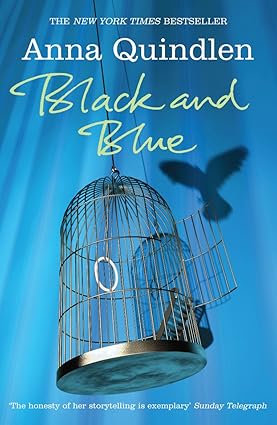
Black and Blue by Anna Quindlen is an American domestic fiction novel first published in 1998 at Random House, New York, U.S.A. Anna the author is known for her distinct voice, which has won her the Pulitzer Prize for the New York Times column, “Public & Private”.
Black and Blue is one of those books that rather than blindly advocating for women, directly puts us in the shoes of abused women, their turbulent silence, and in-mind agony. Emotion eliciting it is!!!!
Content Headings
- Background
- Setting
- Plot Summary
- Themes
- A Sentence Summary
- Why Black and Blue?
- Our Review
Background
American columnist and novelist Anna Quindlen was born in Pennsylvania, U.S. on July 8, 1953. Her passion for writing motivated her to start her career as a journalist in 1974 at about age 20—the same year she graduated from Barnard College.
In 1995, Anna Quindlen left journalism to become a full-time novelist. Three years later, she published her first novel, “Black and Blue”.
The book, now largely categorized as a domestic fiction, was not originally written to discuss domestic violence or anything of that sort, but quite in an attempt to imitate the rich tradition in American fiction: picaresque personal reaction.
In an interview with The John Adams Institute, Anna disclosed that the idea of her debut novel had come from her quest to explore the concept of identity—an issue which she claimed has always concerned her “especially in the lives of women”.
She wanted to know how important a person’s identity could be, and what would be left if one is reduced to base—stripping away everything we have—trading off an old identity for a new one. Anna Quindlen achieved this by looking through the eyes of a fictional female character who fled her abusive husband, left her identity behind, and went ahead to live a new life.
Setting
Anna Quindlen’s domestic fiction “Black and Blue” was set sometime in the late ’90s majorly in the locales of Lake Plata, Florida, and Brooklyn, Manhattan, Philadelphia, New York.
Frannie, before becoming Beth, was married to Bobby in New York. She would later move to Lake Plata with their only child for safety. At Lake Plata, they lived in a small, ‘L-shaped living room’ close to P.S. 135 in Sheepshead Bay, and Robert schooled at St. Stannie’s, LP.
The book publisher spelled it out in their first edition that the book is completely fictional and that any resemblance to persons, events, or locales, ‘is entirely coincidental’.
Plot Summary
Through the eyes of Anna Quindlen, we see a nurse Frannie Frances married to a New York City police officer who was always abusing her physically, s£xually, and mentally. At first, she thought she could stand him in the hope that things would get better especially because she wanted her child to have a father and a home.
She managed to keep her problems a secret from people including her ten-year-old boy, always claiming that she had accidents whenever she had apparent bruises.
One night after such abuse from Bobby, she felt pity for herself and for her little child who she thought wasn’t growing with the kid in him. She thought of what to do and remembered Patty Bancroft, a woman who’d spoken to her at the hospital about her service of providing safety for women under abusive partners. Fran still had her card, she phoned the woman and arrangements were made for her escape.
The book opens with what I’ve tagged “The hell Fran went through under Bobby”.
Other parts of the book starting from the second section until the end discuss her flight from Brooklyn to Lake Plata in Florida where she started a new life with Robert, a recollection of the violent episodes she’d had as Bob’s wife, and how her freedom ultimately came from giving up on unlawfully having her son in her custody.
It turned out that Fran and her son were living under new names, new buildings, new locales, and with new people. She answered Beth Crenshaw while her son maintained Robert but with the last name: Crenshaw. At Lake Plata, they pretended to be the people they were not and eschewed revealing the story of their past.
Beth opened up to Robert on why they had to flee from Bobby and he seemed to perfectly understand and equally care for the wellbeing of his mother, but he’s also always concerned about his daddy’s—he kept asking his mom when they’d return.
It was hard but they soon made new friends and got accustomed to the new setting; Robert’s best friend is Bennie and Beth’s Cindy. Beth started getting involved with Mike Riordan, Robert’s school team coach—something that didn’t go down well with Robert when he first realized it, and as we’d later see, this started making his trust in his mom shaky.
One day after school, Robert told his mom about an argument with a mate, see page 244:
“I said he didn’t know what he was talking about. He didn’t even know what a spic was. I knew from Daddy. Daddy talked about spics with Mr. Hogan and Mr. Carter. He said the spics live like animals and that they k!lled that people man in Washington Heights…”
I winced. “Don’t use that word, Ba,” I said. “Spic is a word that people use to talk about people who are Spanish. Puerto Ricans, Cubans like Bennie. They’re Latino, but people who don’t like them call them spics.”
“That’s not what daddy said. Daddy said the spics messed up the city.”
The argument he had with a colleague at school became his and his mother’s but he went to bed allowing her to have the say.
When he woke up, poor Robert, had issues trusting his mom, so he phoned his dad. Beth caught him while on the conversation and he dropped the receiver. He went:
“You lied to me,” he said, rising to his feet, his eyes only a little lower than my own.
“About what?” I said.
“About a bunch of things”
On page 247.
With the line Robert called, Bobby found all the details he needed about their whereabouts. He went to their apartment at Lake Plata and beat Beth until she was unconscious for the last time. By the time she was conscious, he’d gone with Robert.
Sometime before this incident, Beth had told Mike Riordan about her real identity and the incident wasn’t a surprise to him. He and Cindy took care of Beth until she recovered fully and they attempted to get Robert—to no fruition, though.
Beth found peace in Mike Riordan. They became a couple and had kids together. She moved out of her L-shaped apartment and moved in with Mike leaving there the address to her new place should Robert come to find her.
Themes
There are several things in “Black and Blue”, so we shall discuss them in two groups: major and minor themes.
Major Themes in Black and Blue
1. Legal and Traditional Gender Stance
Role isn’t really the word to use here, so we’ve used stance. In the book, emphasis was laid on the fact that Bobby—being a man—is the rightful owner of the child he has with Frannie. This fact stands both traditionally and legally as the book portrays it. We got this impression in the words of a private investigator speaking with Mike and Beth when they consulted him in search of Robert.
See pages 279-280:
“…I’m not gonna bullshit you, your son is gone, and he’s gonna be hard to find. Your ex is a cop, which means he knows things about making himself scarce… but let’s say you go looking for him and maybe find him. What then? You got 280 no case, is what. You took this guy’s kid and absconded with him. He took him back. It’s maybe you who could get in trouble for this. Assault charges, you might try against him, but it won’t necessarily help you get the child. He goes to court and says “you disappeared with his boy for a year, you are gonna get your head handed to you.”
We also see this theme when Frannie starts to think that her husband might be hitting her more because she made more money—Bobby even made her clear their taxes, as a result. He thinks a wife should be home in the household of her husband.
All these not being in place give the impression that Bobby feels emasculated and as such feeds his ego by hitting Fran.
2. The Insignificance of Love
The impression that love doesn’t keep homes is a throughline in Anna Quindlen’s work. It is evident in the fact that even until the last time of their encounter—toward the end of the book—Beth and Bobby still loved themselves or still managed to believe that they have that feeling toward each other only it is not what keeps couples together; they couldn’t manage to get back together, regardless.
Let’s see an excerpt from page 271:
[Bobby to Beth] “You want to hear something f*cking sad? I loved you. I really f*cking loved you, Frances. But nothing was ever right, nothing was ever good enough. You wanted to do what you wanted to do… just go off, go off, instead of being home, where you belonged. And even when you stayed home, you looked at me and you looked scared all the time, like something bad’s gonna happen… half the time, I only came at you to wipe that goddamned look off your face.”
On page 275, Beth admitted that she felt the same way toward him: “I loved you, too, Bobby”.
Their marriage wasn’t short of love; Bobby would cook for her and take care of her after every hitting episode but he’d hit her again and again. It follows that the role of love, as seen in their marriage, is not to keep homes.
3. Freedom and Search for Security
Beth Crenshaw wanted to be free from the somewhat subliminal captive of Bobby as much as she wanted a safer place for herself and her child Robert.
See page 11:
The secret was k!lling the kid in him and the woman in me, what was left of her. I had to save him, and myself.
The quest to be secure got a better part of Beth, and it remains her priority even after flawlessly escaping the watch of Bobby.
See page 236:
“God forgive me, but there were so many times he went out to work and I would think the best thing that could happen to me was the call, the Chaplin, the casket with the handsome cop I’d married inside it, who would never ever be able to lay a hand on me again, a fist in my face or rough fingers that opened me up…”
4. Misuse of Power
“Don’t you f*cking interrupt me”, Bobby says authoritatively on page 272. He is obsessed with every authority within his reach. Being a cop, he feels he could use power as he wishes and that there’s no one Beth could run to since he’s a part of what he thinks the most handy resort is.
Similarly, he knows the last and so used it to his advantage—in terms of going for his child and putting him under his custody…
See page 273:
“…and she has the nerve to say to me, you been beating her all this time, haven’t you? And I say, you been diddling her all this time, too. She shut the f*cking door in my face and called the cops. The cops!” Bobby threw back his head and laughed.
5. Domestic Violence
This domestic fiction prose gives a good insight into the domestic violence—mental, emotional, s£xual, and physical abuse—a woman encountered with her husband, whom she’d eventually leave.
If any, this theme triggered the dissolvement of Frannie and Bobby’s union the most; both are very often not at peace with each other.
See pages 5 and 18:
5 He just held into my upper arm so tight that the mark of his fingertips was like a tattoo, a black sum with four small moons revolving around it.
18 Although it was always hard to tell exactly what would offend [him] until the moment when he put his head to one side and looked me up and down until my pale skin flushed. “Jesus Christ,” he’d said in that voice. “You wearing that?” and I would feel like a whore, me, plain Frannie Benedetto…
6. Fear and Anxiety
The protagonist, Beth Crenshaw, originally Frannie Frances, was tense almost all through the book until it caused her the worst and she had nothing else to fear. Fear governed all that Beth did. We see this from the point where she’d spoken on the phone to a male worker at the hospital where she worked as if it were some woman—or such was the impression she gave her overprotective husband Bobby.
See an instance of her fear on page 106:
“They want me to page for their kid”, said the girl, “They can’t find him. I told them I couldn’t page without you saying so.”
“He’s ten,” I said. “He was supposed to be in the comic aisle. Where the cards and magazines are.”
“Skinny kid?” said Lenny. “Dark hair, green shirts?”
“Yes”, I said knowing the worst, knowing what Lenny would say next, describing the man who’d left with the kid as dark, nice-looking, big through the arms and shoulders, looked like the kid, looked like the dad. And Mike Riordan would want to call the police, and I would want to d!e, right here in the supermarket, rather than go home to that apartment alone. Or back to Brooklyn.”
7. Identity
In addition to the highlight given in the background of this work, the concept of identity is another essential theme of this work—the one in the mind of the author at its genesis.
Through it, we see how difficult but realistic it is to live meaningfully after having stripped one’s original identity away.
Identity is what I’d regard as an umbrella theme of Black and Blue; we see it sheltering several other themes—only, some themes brought the book to see identity.
Minor Themes in Black and Blue
- Learned behaviour
- Motherhood
- Pain
- Doubt
- Alcohol overconsumption
- High levels of stress
A Sentence Summary
In search for peace, we see a woman once passionate about her family and job forced to leave her toxic husband, absconding with their only child to another city where they took up new identities until the toxic man would come for his child—left with nothing to hide, the woman started a new home with a new man in addition to everything she has made new about herself.
Why Read Black and Blue?
This book title isn’t literally about colors, it is the connotative meaning of the colors used. Black signifies a threat or some glumly mood while Blue signals depression and anger. Put together, the Cambridge English Dictionary defines “Black and Blue” as “…marks on your skin caused by being hit or having an accident.”
Coincidentally enough, Fran told everyone who asked that she had an accident whenever Bobby hit her and left scars.
Our Review
The subject of domestic violence, especially between couples, is not a path that is often carefully beaten in fiction works, due in large part to its complexity. But with “Black and Blue”, Anna Quindlen gives a crisp view of this phenomenon and it bolsters the fact that love isn’t what keeps partners at peace.
Quite subjectively, I believe “Black and Blue” is one of the books one should read after Murray Straus’ and Gelles’ “Intimate Violence” which gives many brief vignettes of the account of violent homes and how they seek safety—with emphasis on abused women.
In “Intimate Violence”, we see several short narratives of domestic violence, whereas “Black and Blue” delves deeply into the marriage life of a woman—its concentration on just one disillusioned woman elicits greater empathy and understanding in the mind readers.
In light of this, we strongly recommend that everyone who wishes to explore more about domestic fiction gets a copy of Black and Blue. It could help improve the level of your empathy, too.